
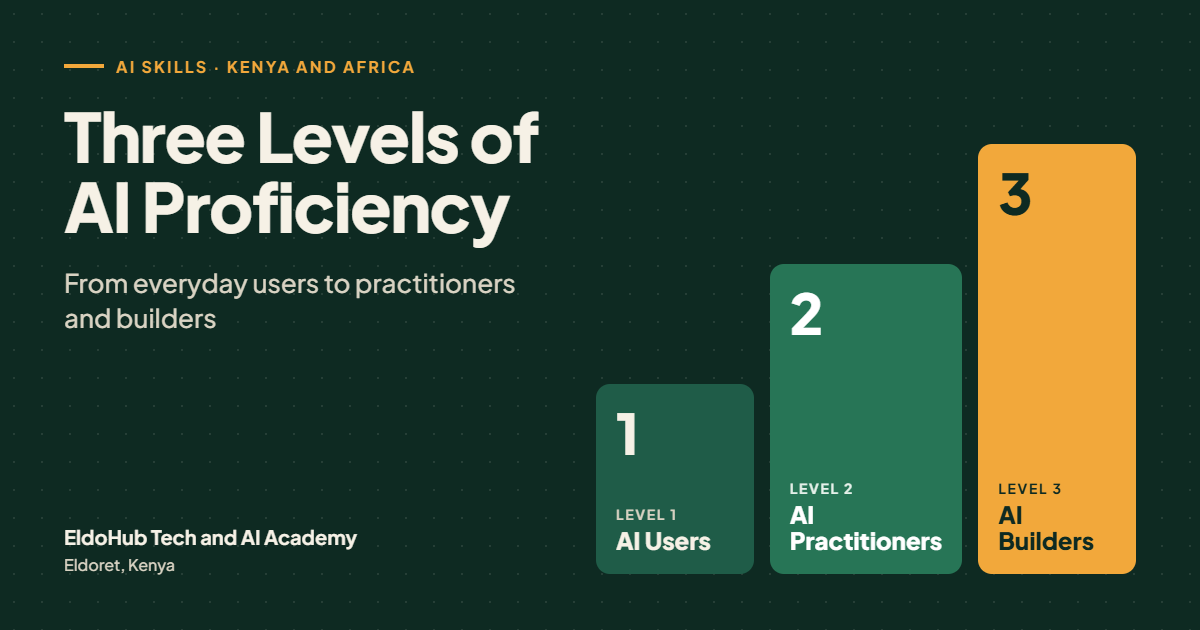
Using AI, working with AI and building with AI are three different skill levels. This guide explains each one with examples from Kenya and across Africa, and shows how to move from one level to the next.
Using AI, working with AI and building with AI are three different skill levels. This guide explains each one with examples from Kenya and across Africa, and shows how to move from one level to the next.
Key takeaways(TLDR)
- AI proficiency has three levels. AI users ask questions and draft content. AI practitioners produce verified, professional work and automate workflows. AI builders create AI agents, applications and integrated systems.
- Kenya leads the world in AI use, but use is not the same as skill. The Digital 2026 Mid-Year Global Update found that 97.5% of Kenyan internet users aged 16 and above used an AI tool in the past month, the highest of the 54 countries tracked.
- Intent is outrunning capability. KPMG's Global Tech Report 2026 found that nearly 70% of Kenyan organisations plan to fully adopt AI by the end of 2026, yet only 26% have done so.
- Skills are the bottleneck across Africa. SAP's research shows 94% of African organisations now offer IT training at least monthly, even as the share of budgets for skills development falls.
- The rules are still taking shape. Kenya's National AI Strategy 2025–2030 was launched on 27 March 2025. The country has no dedicated AI law yet, so the Data Protection Act, 2019 remains the main safeguard for personal data.
- The right level depends on your goal. An SME owner, a SACCO manager, an agronomist and a software developer in Eldoret, Nairobi, Kisumu or Mombasa need different levels of AI skill.
Kenya leads the world in AI use. Is that enough?
Artificial intelligence is changing how Kenyans learn, work, trade and build businesses. A student in Eldoret uses it to understand a hard concept. A shopkeeper in Gikomba drafts product descriptions with it. A farmer's cooperative in Nakuru uses it to organise production records. A fintech team in Nairobi uses it to power customer support.
The adoption numbers are striking. The Digital 2026 Mid-Year Global Update Report, published by DataReportal with We Are Social, found that Kenya has the highest monthly AI use of any country it tracks. Commentators link this to Kenya's record of leapfrogging older technology, most famously with mobile money.
Yet access to AI does not automatically mean the ability to use it well. KPMG's Global Tech Report 2026 shows the gap clearly: close to 70% of Kenyan organisations intend to fully adopt AI by the end of 2026, but only 26% have managed it so far. Across the continent, the World Economic Forum's Future of Jobs Report 2025, as cited by ITWeb, found that more than 60% of companies see skills gaps as a key barrier to business transformation. Projections reported by The New Times suggest AI could create 230 million digital jobs across Africa by 2030, but those jobs will go to people who are prepared for them.
That is why it helps to separate using AI, working with AI and building with AI. They are three different levels of proficiency. Knowing where you stand today tells you which skills to develop next and which training to choose.
The levels are not rigid. Many people work across more than one, and none of them ranks human intelligence or professional worth.
What are the three levels of AI proficiency?
- Level 1, AI users: people who use conversational AI tools such as ChatGPT, Gemini and Claude to ask questions, brainstorm, summarise and draft.
- Level 2, AI practitioners: people who apply AI to real professional tasks, produce verified deliverables such as reports, analyses and proposals, and build repeatable workflows and automations.
- Level 3, AI builders: people who design, develop, test and deploy AI-powered applications, agents and integrated systems for specific users and organisations.
Level 1: AI users, the everyday explorers
An AI user is someone who uses a conversational AI tool to get information, generate ideas or simplify everyday tasks. For many Kenyans this is the first step into artificial intelligence.
What do AI users do?
- Ask questions and understand unfamiliar concepts, in English, Kiswahili or a mix of both.
- Summarise articles, reports and long documents.
- Generate ideas for projects, businesses and content.
- Draft emails, WhatsApp messages and social media posts.
- Translate text and improve grammar and writing.
- Learn new skills and explore unfamiliar topics.
- Brainstorm solutions to everyday challenges.
A university student in Kabarak or Moi University might ask AI to explain a research method. A small business owner in Nairobi might generate Instagram captions for a new product. A county officer might summarise a long circular before a meeting. These are valuable uses. AI can shorten the time it takes to find information, overcome the blank-page problem and make knowledge more accessible.
The limitations of casual AI use
It is easy to assume that an impressive answer is an accurate, complete or suitable one. It often is not. AI systems can produce incorrect information, miss important context and state uncertain claims with confidence. They may also give generic answers that ignore local conditions.
Asking an AI tool to "write a business plan" produces a reasonable starting point. But it will not know your real costs, your customers in Kitale or Kisumu, the cost of electricity and transport in your area, Kenya Revenue Authority obligations or your county licensing requirements. Asking it to analyse a spreadsheet without supplying the data, the business question and a way to check the calculations has the same problem.
There is also a privacy risk. Pasting customer lists, M-Pesa statements, staff records, learner data or confidential contracts into a public AI tool can expose sensitive information. Kenya's Data Protection Act, 2019 places obligations on anyone who handles personal data, so this matters for individuals as well as organisations.
The problem is not that AI is ineffective. Access to AI does not automatically translate into the ability to use it effectively.
What should AI users learn next?
- What AI can and cannot do.
- How to write clearer instructions and give relevant context, including Kenyan context such as location, currency (KES), sector and audience.
- How to spot hallucinations, bias and unreliable outputs, especially on local laws, prices, place names and statistics.
- How to protect confidential and personal data.
- How to verify important claims against trusted sources before using them.
- When human judgement is necessary.
This is the foundation of AI readiness: the awareness, confidence and judgement to use AI responsibly. The next level begins when a person stops only asking questions and starts consistently using AI to complete real work.
Level 2: AI practitioners, people who get work done with AI
An AI practitioner applies AI systematically to professional tasks and turns it into measurable, verified work outputs. The goal is not just an answer. It is a useful deliverable such as a report, a proposal, an analysis, a training module or a working automation.
From prompting to professional output
Prompting matters at this level, but practice goes well beyond clever prompts. A practitioner defines the task and the required output, supplies source material and context, sets constraints, checks the result and improves it.
Instead of typing "analyse our sales", a practitioner uploads a sales dataset, states the business objective, names the metrics to examine, asks for a breakdown by product and county or region, and requests a structured report that highlights trends and anomalies. They then verify the calculations, investigate surprises and use the findings to support a decision.
This takes task definition, workflow design, data literacy, quality control and knowledge of the sector.
How AI practitioners work across Kenyan and African industries
1. Business, SMEs and administration. Draft business proposals, standard operating procedures and meeting briefs, turn meeting notes into action lists, and prepare reports. Small and medium enterprises are central here: Google and UpSkill Universe note that small businesses create over 80% of jobs on the continent.
2. Finance, SACCOs and mobile money. Classify transactions, reconcile M-Pesa and bank statements, flag unusual entries, compare budgets with actual spending and explain changes in performance. Calculations and decisions still need verification, controls and professional oversight.
3. Marketing and communications. Build content calendars, create campaign variations for WhatsApp, Facebook, TikTok and Google, analyse customer feedback and summarise campaign results. This includes writing content that is easy for search engines and AI answer engines to find and cite.
4. Education and training. Develop lesson plans, learning materials and assessment questions aligned to the Competency-Based Curriculum or technical and vocational (TVET) standards, adapt explanations for different learners and analyse learner feedback. The educator stays responsible for accuracy, assessment quality and learner wellbeing.
5. Agriculture and agribusiness. Organise farm and cooperative records, summarise extension advice, analyse yields and input costs, and prepare reports for buyers, funders and county programmes.
6. Data analysis and research. Clean datasets, write spreadsheet formulas, generate analysis code, summarise research and communicate findings through reports and charts. AI assists the analysis, and the practitioner remains responsible for the evidence and its interpretation.
7. NGOs, county governments and public service. Prepare grant proposals, monitoring and evaluation reports, policy briefs and public communication, and summarise citizen feedback. Work involving personal data needs particular care.
8. Human resources and operations. Draft job descriptions, onboarding guides and internal policies, and map business processes. In recruitment and staff evaluation, practitioners must consider privacy, bias, fairness and Kenyan employment law.
AI automation: moving beyond individual tasks
The step from isolated tasks to repeatable workflows is where AI starts to deliver business value. A person might begin by summarising one document manually. With the right tools, that becomes a process:
- A document, such as a supplier invoice or a customer form, arrives through an approved channel.
- An automation extracts its contents.
- An AI model classifies the document and summarises the key information.
- The system records the output in a spreadsheet or business application.
- A human reviews the result when required.
- The workflow sends a notification or prepares the next action.
Practitioners use visual automation platforms, spreadsheet integrations, APIs, AI-enabled business applications and workflow tools to do this. They do not need to be software developers, although technical knowledge becomes more valuable as workflows grow more complex. The aim is to reduce repetitive work, improve consistency, speed up delivery and free people for work that needs judgement.
The skills that set effective AI practitioners apart
- Advanced prompting: clear objectives, context, constraints, examples and output requirements.
- Document creation: structured reports, proposals, policies, presentations and other professional deliverables.
- Data analysis: investigating data, generating formulas or code, and communicating findings.
- Workflow design: breaking a task into stages and finding where AI adds value.
- Automation: connecting tools to run repeatable tasks with little manual effort.
- Verification and quality control: checking accuracy, completeness, relevance and compliance.
- Sector knowledge: understanding the real work, standards, risks and decisions in a field.
How to recognise an AI practitioner
Two professionals are asked to produce the same report. The first asks AI to write it, copies the response and sends it to a manager. The second defines the report's purpose, supplies the source documents, sets the structure, checks the facts, validates the figures, improves the analysis and delivers a polished report that supports a decision.
Both used AI. Only the second has a repeatable working method, and that is what gives practitioners a real workplace advantage. As employers increasingly look for people who can apply AI inside real workflows, rather than only prompt it, this level is where many Kenyan professionals, trainers and entrepreneurs will see the fastest returns.
Level 3: AI builders, people who create AI-powered solutions and systems
An AI builder designs and develops AI-powered solutions for specific users, organisations and operational needs. These include custom AI agents, internal assistants, document-processing systems, customer support tools, research assistants and software products with AI at their core.
Where a practitioner asks, "How can I use AI to complete this task?", a builder asks, "How can I design a system that completes this task reliably, repeatedly and at the scale the organisation needs?"
What does it mean to build with AI?
Building with AI does not always mean training a new model from scratch. Most builders combine existing models with software, business data, databases, APIs, automation platforms and carefully designed instructions.
Take a county health office, a SACCO or a university that wants an internal assistant answering staff and member questions from approved policy documents. A builder could design a system that:
- Connects to the organisation's authorised document repository.
- Retrieves relevant information when a question is asked.
- Uses an AI model to answer based on that information.
- Cites the source documents.
- Enforces access permissions and protects personal data.
- Records system events for monitoring and troubleshooting.
- Escalates questions it cannot answer reliably to a person.
The result is not a chat with a general-purpose chatbot. It is a purpose-built application shaped around an organisation's information, rules, users and workflows.
AI agents: from responding to pursuing goals
An AI agent is a system that uses an AI model to interpret a goal, decide on steps and use permitted tools or systems to complete a task, often with some autonomy. Unlike a simple chatbot, an agent can retrieve information, call an API, search a database, update a record, generate a document or trigger an approved workflow.
A customer service agent for a Kenyan business could:
- Receive a customer query by web chat or WhatsApp.
- Identify the issue and the relevant customer details.
- Search an approved knowledge base.
- Retrieve the order or service record.
- Recommend a response or action.
- Ask for human approval in sensitive or exceptional cases.
- Record the interaction in the right system.
Some systems coordinate several agents, although not every problem needs that. The key point is that agents need clear permissions, reliable data, defined boundaries and human oversight. More autonomy does not automatically mean better results.
Building AI solutions for African realities
Good AI products for Africa are designed around local conditions, not copied from elsewhere.
- Language: Many users think and write in Kiswahili, Sheng or mother-tongue languages, and often switch between them and English. Builders must test how models handle this, because performance in lower-resource African languages is often weaker.
- Connectivity and cost: Internet quality varies across regions, and data is expensive. Lightweight designs, WhatsApp, SMS or USSD interfaces and offline-tolerant features can reach more people than a heavy web app.
- Payments and identity: Solutions often need to work with M-Pesa, Airtel Money, bank APIs and local identity or verification systems.
- Data location: Kenya's AI strategy emphasises investment in local infrastructure so that data can stay within national borders, which matters for regulated and public-sector systems.
- Trust and fairness: Systems must work for users with different languages, literacy levels and devices.
AI builder opportunities across sectors
1. Health and health administration. Tools that help authorised staff search clinical guidelines, organise administrative records or process approved forms. These require strong privacy, validation, access controls and clinical oversight. AI should not replace professional medical judgement.
2. Banking, SACCOs, insurance and fintech. Document extraction, policy search, compliance research, fraud-monitoring support and customer service workflows. Builders must plan for security, auditability, regulation and the cost of wrong decisions.
3. Agriculture and agribusiness. Farm record systems, knowledge bases for extension advice, production data analysis, and interpretation of weather, market or crop information from reliable sources. Advanced systems can add sensors, satellite imagery and forecasting models. The National AI Strategy itself points to predictive analytics and precision farming for food security.
4. Education and learning. Curriculum-aligned learning assistants, personalised practice tools, assessment support and administrative automation. Good designs include educational objectives, age-appropriate safeguards, teacher oversight and checks that prevent confidently teaching wrong information.
5. Manufacturing, logistics and supply chains. Maintenance-document search, inventory analysis, demand forecasting, logistics coordination and operational report processing. Where AI touches physical equipment or critical infrastructure, rigorous engineering safeguards and testing are essential.
6. Legal, consulting and professional services. Retrieval from authorised case files, document comparison, clause extraction and research organisation. These need confidentiality controls, traceable sources and qualified human review.
The technical capabilities of an AI builder
The skills required depend on the complexity of the solution. Common areas include:
- AI model integration: working with language models through APIs, model platforms or approved deployment environments.
- Retrieval-augmented generation (RAG): building systems that fetch relevant information from an external knowledge base before generating an answer.
- Agent and workflow design: defining how a system plans tasks, uses tools, handles failures and escalates to humans.
- Software and application development: using programming languages, frameworks, low-code or no-code platforms to create working applications, including mobile-first and web apps.
- Data and system integration: connecting AI to databases, document repositories, enterprise software and APIs.
- Evaluation and testing: measuring whether a solution is accurate, useful, consistent and grounded in the right sources under realistic conditions.
- Security and governance: designing permissions, protecting data, managing costs, logging events and guarding against misuse.
- Deployment and monitoring: releasing the solution to users, watching performance, fixing failures and maintaining it as needs change.
Not every builder needs expertise in every area. No-code and low-code tools make useful solutions possible without deep programming experience, but more demanding applications call for stronger software engineering, data engineering and security skills.
Why building needs a different mindset
A demo that works once is not a system you can trust every day. A custom AI application must answer questions such as:
- What happens when source data is incomplete or out of date?
- How does the system behave when it does not know the answer?
- Can unauthorised users reach restricted information?
- How are wrong outputs detected and corrected?
- What happens when an external API fails or the network drops?
- How much does each task cost to run?
- Can it handle the expected number of users and requests?
- How will performance be monitored over time?
These questions separate a promising prototype from a dependable operational system. Successful builders combine technical creativity with disciplined engineering: they understand the problem before choosing the technology, test against real requirements and design for reliability rather than novelty.
Comparing the three levels of AI proficiency
The levels describe a widening scope of what a person can accomplish with AI. They are not a ranking of intelligence or professional worth.
|
Dimension |
AI users |
AI practitioners |
AI builders |
|---|---|---|---|
|
Primary focus |
Accessing information and assistance |
Completing professional tasks and improving workflows |
Creating AI-powered applications and systems |
|
Typical activity |
Asking questions, brainstorming, summarising |
Producing documents, analysing data, automating tasks |
Developing agents, integrations and custom solutions |
|
Main tools |
Conversational AI apps |
AI tools, spreadsheets, automation platforms, business applications |
Models, APIs, databases, development frameworks, agent platforms |
|
Working method |
Prompt and review |
Define, execute, verify, improve |
Design, build, test, deploy, maintain |
|
Typical output |
An answer, idea or draft |
A finished deliverable or repeatable workflow |
A reusable system or application |
|
Core skills |
AI literacy, clear instructions, critical thinking |
Prompting, sector expertise, analysis, workflow design |
System design, integration, evaluation, security, engineering |
|
Value created |
Personal productivity and learning |
Professional and operational productivity |
Scalable capabilities and new ways of working |
A skilled practitioner can create enormous value without becoming a developer, and a builder still needs the foundations of an everyday user. The right level depends on the problems you need to solve. An accountant improving month-end reporting may need practitioner skills. A business owner who wants an assistant connected to company records needs builder skills. Someone just starting out should first build AI readiness.
Responsible AI in Kenya: what every user, practitioner and builder should know
Kenya has an AI strategy and strong data protection rules, but no dedicated AI law yet. That makes personal responsibility more important at every level.
- National AI Strategy 2025–2030. The Ministry of Information, Communications and the Digital Economy launched it on 27 March 2025 at the Kenyatta International Convention Centre, with ICT Cabinet Secretary William Kabogo leading the launch. It aims to position Kenya as an AI leader in Africa, aligns with Vision 2030 and the African Union's Continental AI Strategy of June 2024, and rests on three pillars supported by four enablers.
- Data Protection Act, 2019. This is the main legal safeguard when AI touches personal data. Anyone processing personal data, including customer, learner, patient or employee information, should understand their duties and the role of the Office of the Data Protection Commissioner.
- Regulatory gaps. The strategy itself notes that Kenya lacks a dedicated AI legal framework and relies on data protection law, sector policies and proposals such as the Kenya Robotics and AI Society Bill (2023) and the Draft IT Artificial Intelligence Code of Practice (2024).
- Draft policy in progress. Public consultation on the draft Kenya Artificial Intelligence and Other Emerging Technologies Policy 2026 closed on 4 August 2026. Rules may change, so check current requirements before deploying AI in regulated sectors.
Good habits at every level
- Never paste personal, financial or confidential data into a public AI tool without authority and a clear reason.
- Verify facts, figures, laws and quotations before you publish or act on them.
- Keep a human in the loop for decisions about people, money, health and legal rights.
- Be open about where AI was used in your work when it matters to your audience.
- Test AI outputs for bias, especially across language, gender, region and income groups.
Which level are you at? A quick self-check
- Mostly Level 1 if you use AI for questions, ideas and drafts, and rarely check or reuse the results in a structured way.
- Level 2 if you give AI source material and clear requirements, verify what it produces, and deliver finished work or run repeatable workflows with it.
- Level 3 if you design and ship systems that use AI models, data and tools for other people, with testing, security and monitoring.
Most people sit across levels. Pick the level that matches the problems you want to solve.
From AI awareness to AI capability: a three-stage pathway
As AI tools become cheaper and easier to reach, the difference between having access and having capability becomes a career and business advantage. Opening an AI app is a starting point. Producing reliable work with it is a professional skill. Designing and maintaining an AI-powered system is a technical skill.
- Become AI-ready. Learn AI fundamentals, find suitable use cases, build responsible habits and learn to evaluate outputs.
- Become an AI practitioner. Apply AI to real tasks, produce professional deliverables, analyse data and design repeatable workflows and automations.
- Become an AI builder. Learn to design, integrate, test and deploy custom AI agents, applications and systems that solve specific problems.
People can enter at any point. What matters is that learning turns into demonstrated capability, which is also what employers, clients and funders increasingly look for. Africa is investing in this too: initiatives such as Google's AI Skilling Blueprint for Africa and its Hustle Academy programme for small businesses aim to widen access to AI skills.
AI training in Eldoret and across Kenya: EldoHub Tech and AI Academy

EldoHub Tech and AI Academy in Eldoret, Kenya, supports individuals, businesses, schools and organisations with different starting points and ambitions. Our AI training follows the three levels of proficiency: AI readiness, AI practice and AI building.
AI readiness training
For individuals and teams new to AI, or those who want a strong foundation. It covers how AI works, practical use cases, effective use of AI tools and their limitations. The goal is the confidence and judgement to use AI responsibly and productively.
AI practitioner training
For professionals, entrepreneurs, trainers and teams who want to move beyond basic prompting. It centres on advanced prompting, professional document creation, data analysis, research, workflow design and task automation. The emphasis is on producing useful outputs that work in real Kenyan business and professional settings.
AI builder training
For learners who want to create AI-powered solutions. Depending on the pathway, it can include AI model integration, agent workflows, knowledge-base systems, automation, application development, testing and responsible deployment. The goal is to move from using existing AI tools to designing solutions for specific organisational and industry needs.
Ready to start? Contact EldoHub Tech and AI Academy to discuss your starting point and choose the pathway that fits your goals.
The future belongs to people who know what to do with AI
AI is not a single skill. It runs from everyday use, to professional application, to technical development. Users learn to work with intelligent tools, practitioners turn those tools into meaningful work, and builders create systems that extend what people and organisations can do.
Kenya already leads the world in how many people use AI. The next step is to lead in how well they use it. The question is no longer only whether you use AI. It is what you can accomplish with it, and what you can build when you use it well.
Frequently asked questions about AI skills in Kenya and Africa
What are the three levels of AI proficiency?
The three levels are AI users, AI practitioners and AI builders. Users ask questions and draft content with AI tools. Practitioners apply AI to real work and produce verified deliverables and automations. Builders design and deploy AI agents, applications and integrated systems.
What is the difference between an AI user and an AI practitioner?
An AI user mainly asks AI for answers, ideas and drafts. An AI practitioner defines a task, supplies source material, checks the results and delivers finished, professional work using a repeatable method.
What is an AI builder?
An AI builder creates AI-powered solutions, such as custom agents, internal assistants and document-processing systems, by combining existing models with software, data, APIs and automation. Builders also test, secure, deploy and maintain what they create.
Is Kenya really the world leader in AI use?
By one major measure, yes. The Digital 2026 Mid-Year Global Update Report found that 97.5% of internet users aged 16 and above in Kenya used AI tools monthly, the highest among 54 countries tracked. This measures how many people use AI, not how skilled they are, and it covers internet users rather than the whole population.
What is Kenya's National AI Strategy 2025–2030?
It is the government's roadmap for AI, launched by the Ministry of Information, Communications and the Digital Economy on 27 March 2025. It aims to make Kenya a leader in AI in Africa and covers infrastructure, skills, governance and priority sectors such as agriculture and health.
Does Kenya have an AI law?
Not a dedicated one at the time of writing. The National AI Strategy notes that Kenya relies on data protection law, sector policies and proposed bills and codes. The Data Protection Act, 2019 applies whenever AI processes personal data. A draft AI policy was open for public consultation until 4 August 2026, so check for updates.
Do I need to know how to code to use AI at work?
No, not for AI user or AI practitioner levels. Practitioners can do a great deal with AI tools, spreadsheets and no-code automation platforms. Coding and software engineering skills become important at the AI builder level, although low-code tools can help beginners.
Which AI skills are most in demand in Kenya?
Employers increasingly value people who can apply AI inside real workflows, not just prompt it. Useful skills include clear instructions, data analysis, document creation, workflow automation, verification of outputs and knowledge of data protection.
How can small businesses in Kenya start using AI safely?
Start with low-risk tasks such as drafting marketing content or summarising documents. Remove personal and confidential data first, verify every output, keep a person responsible for decisions, and then move to repeatable workflows once the basics work.
Where can I get AI training in Eldoret and Kenya?
EldoHub Tech and AI Academy in Eldoret offers training across AI readiness, AI practitioner and AI builder pathways for individuals, teams and organisations. Contact the academy to discuss which pathway fits your goals.
Sources
Figures below came from search results checked on 29 October 2026. Re-confirm each against the original page before publishing.
- Kenya tops global AI usage rankings, ITWeb Africa: 97.5% monthly AI use, 54 countries, Digital 2026 Mid-Year Global Update.
- Kenya tops world in AI adoption, TechTrends Kenya, 14 Aug 2026: draft Kenya AI and Other Emerging Technologies Policy 2026, consultation closed 4 August.
- Kenya ranks first globally on AI usage, Capital FM
- AI adoption in Kenya returns gap, TechTrends Kenya, 29 Jan 2026: KPMG Global Tech Report 2026, about 70% intent versus 26% achieved.
- Kenya: Unveiling of the National AI Strategy 2025–2030, Bowmans: launch on 27 March 2025.
- Kenya releases the National AI Strategy 2025–2030, EY Tax News: no dedicated AI law, AU Continental AI Strategy alignment.
- The Kenya National AI Strategy 2025–2030: Regional and Global Positioning, CIPIT, Strathmore University
- Urgent need for AI skills development accelerates across Africa, SAP News Africa
- Africa races to build AI skills as training demand surges while budgets lag, ERP Today
- Microsoft SA rolls out AI upskilling initiative, ITWeb: World Economic Forum Future of Jobs Report 2025 on skills gaps.
- The AI skills gap: your make-or-break moment, The New Times: 230 million digital jobs projection by 2030.
- Google and UpSkill Universe redesign Hustle Academy, Tech Africa News: small businesses create over 80% of jobs.
- Google unveils AI Skilling Blueprint for African governments, Nairametrics